89,000 people can’t be wrong

Just hours from now, Apple will unleash its own form of happiness in the form of a shiny new ithing. More importantly, UC Berkeley launches a Massive Online Course. join 89,000 of your new best buddies for this Mooc on the Science of Happiness. 


The course will include:

  • Short videos featuring the co-instructors and guest lectures from top experts on the science of happiness;
  • Articles and other readings that make the science accessible and understandable to non-academics;
  • Weekly “happiness practices”—real-world exercises that students can try on their own, all based on research linking these practices to greater happiness;
  • Tests, quizzes, polls, and a weekly “emotion check-in” that help students gauge their happiness and track their progress over time;
  • Discussion boards where students can share ideas with one another and submit questions to their instructors.

The Science of Happiness

Starts September 9, 2014 – Register Now!

An unprecedented free online course exploring the roots of a happy, meaningful life. Co-taught by the GGSC’s Dacher Keltner and Emiliana Simon-Thomas. Up to 16 CE credit hours available.
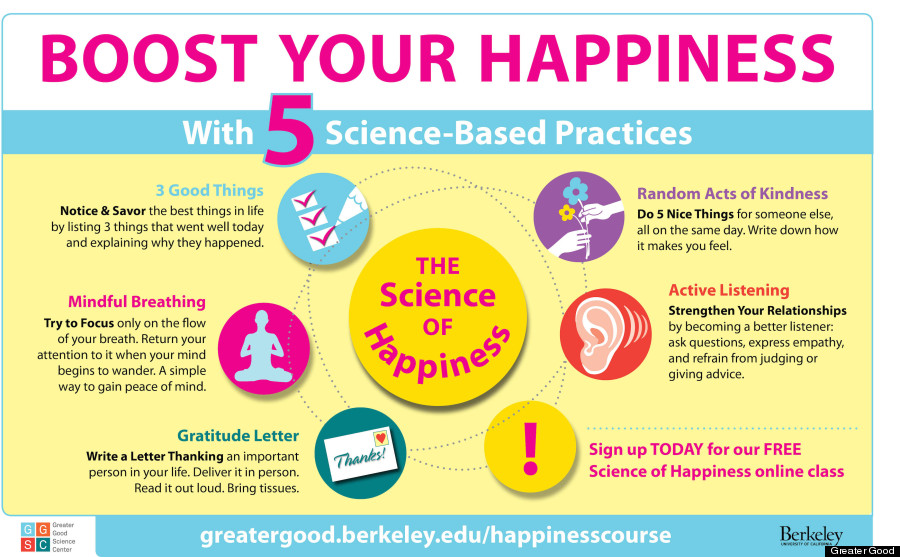
Register now!


It is fitting this course starts the day before World Suicide Prevention Day. 

Follow your passion is bad advice

“The path to a passionate life is often way more complex than the simple advice ‘follow your passion’ would suggest.”
You’ve been told you should follow your passion, to do what you love and the money will follow. But how sound is this advice? Cal Newport argues that it’s astonishingly wrong.

But if you do what you do with passion, it make all the difference. 

He actually mentions Strengthsfinder as a tool, but is kind of dimissive of it. The stories he tells of people living their passions, however, he speaks of lifestyle traights they are cultivated through thir job which sounds suspiciously like people using their strengths in their work. 


Empathy is one of Gallup’s Strengths:

Operationally, it seems connected with Social Intelligence in the VIA schema. 

Greater Good Describes it as  “a wide range of experiences. Emotion researchers generally define empathy as the ability to sense other people’s emotions, coupled with the ability to imagine what someone else might be thinking or feeling.”

How does it work?


Want to understand the science behind empathy? This quick video explains why and when we care.


Communicating Science Through Visual Media – Empathy from RISD FAV on Vimeo.


Want to Cultivate it? The Greater Good Society has outlined the Habits you need to engage in:

Habit 1: Cultivate curiosity about strangers

Habit 2: Challenge prejudices and discover commonalities

Habit 3: Try another person’s life

Habit 4: Listen hard—and open up

Habit 5: Inspire mass action and social change

Habit 6: Develop an ambitious imagination


Finding and building flow

What’s your flow profile?

Don’t know the answer? Well there is a personality test to help you capture it. What is flow?

Csikszentmihalyi is credited with defining the experience as “being completely involved in an activity for its own sake. The ego falls away. Time flies. Every action, movement, and thought follows inevitably from the previous one, like playing jazz. Your whole being is involved, and you’re using your skills to the utmost.”

How often do people experience flow?

“If you ask a sample of typical Americans, “Do you ever get involved in something so deeply that nothing else seems to matter and you lose track of time?” roughly one in five will say that this happens to them as much as several times a day, whereas about 15 percent will say that this never happens to them. These frequencies seem to he quite stable and universal. For instance, in a recent survey of 6,469 Germans, the same question was answered in the following way: Often, 23 percent; Sometimes, 40 percent; Rarely, 25 percent; Never or Don’t Know, 12 percent.” (Source: Psychology Today)

Nakamura and Csíkszentmihályi identify the following six factors as encompassing an experience of flow. 

  1.     intense and focused concentration on the present moment
  2.     merging of action and awareness
  3.     a loss of reflective self-consciousness
  4.     a sense of personal control or agency over the situation or activity
  5.     a distortion of temporal experience, one’s subjective experience of time is altered
  6.     experience of the activity as intrinsically rewarding, also referred to as autotelic experience
Csíkszentmihályi follows build’s on Maslow’s notion of Peak Experience: “Peak experiences are transient moments of self-actualization.”

Jamie Wheal has spent much of his adult likfe researching flow:

He explains his ideas in this compelling TED talk: Hacking the GENOME of Flow: 

His colleague goes deeper in the Rise of Superman

Strengths finder videos

 Andrew Sokolovich has been busy creating short video descriptions–30 to 45 seconds– for the Strengthfinder Themes; 18 of the 34 are now available on Youtube with more to come. With great production values, these are wonderful snapshots for those interested in their strengths. Take Input for a wonderful example:


Take two minutes to teach mindfulness

A growing amount of attention has been given to mindful practices in the classrom. This week, The Guardian profiled what is happening in a UK school with positive effects:

“The whole process of mindfulness has the knock-on effect of making people more receptive and open,” Woods explains. “What we are trying to do is help them become more aware of themselves in a non-judgemental way. By the time the students leave in year six, they have an emotional intelligence and a set of skills that really equip them to cope with everyday life.”

Here are five resources to help introduce mindfulness into your classroom:

• Meditation for beginners

• Mindful mind skills

• 10 mindfulness exercises for the classroom

• Mindfulness and the art of chocolate eating

• A mindfulness relaxation exercise

Be sure to check out their sidebar stories

arbejdsglæde vs karoshi

Would you rather be Happy at Work or Worked to death?

Denmark, often ranked as one of happiest place on earth and one of the best countries to live on subscribe to arbejdsglæde, a Danish word meaning Happy at Work. Alexander Kjerulf explains, “ there is a word for it in Danish because Danish workplaces have a long-standing tradition of wanting to make their employees happy. To most Danes, a job isn’t just a way to get paid; we fully expect to enjoy ourselves at work.” . 


The Japanese, to contrast, have karoshi,  meaning to work oneself to death.  I first encountered karoshi during a  screening of Happy, the Movie. But the term first entered the Japanese lexicon in 1969 and gained popularity of usage in the 1980’s. The Chinese have a similiar term, guolaosi, as do the Koreans, gwarosa.


The Japan Times notes “A growing body of evidence indicates that workers in high-demand situations who have little control of their work and low social support are at increased risk of developing and dying of cardiovascular disease, including myocardial infarction and stroke. Stressful work conditions are a critical component of this phenomenon.” The International Labor Organization profiles some typical cases:

Here are some typical cases of Karoshi:

  1. Mr A worked at a major snack food processing company for as long as 110 hours a week (not a month) and died from heart attack at the age of 34. His death was approved as work-related by the Labour Standards Office.
  2. Mr B, a bus driver, whose death was also approved as work-related, worked more than 3,000 hours a year. He did not have a day off in the 15 days before he had stroke at the age of 37.
  3. Mr C worked in a large printing company in Tokyo for 4,320 hours a year including night work and died from stroke at the age of 58. His widow received a workers’ compensation 14 years after her husband’s death.
  4. Ms D, a 22 year-old nurse, died from a heart attack after 34 hours’ continuous duty five times a month.

Happily, things are changing as lawsuits are forcing companies to change their ways least they be responsible for unlawful death payments. 

So how to pursue arbejdsglæde?

Check out the arbejdsglæde website for specific examples and tips. 

Go to a grateful college

Gratitude: 

— n
  a feeling of thankfulness or appreciation, as for gifts or favours

Much research has come out recently on the positive impact of practicing gratitude. “We’ve studied more than one thousand people, from ages eight to 80, and found that people who practice gratitude consistently report a host of benefits:


Physical
• Stronger immune systems
• Less bothered by aches and pains
• Lower blood pressure
• Exercise more and take better care of their health
• Sleep longer and feel more refreshed upon waking

Psychological
• Higher levels of positive emotions
• More alert, alive, and awake
• More joy and pleasure
• More optimism and happiness

Social
• More helpful, generous, and compassionate
• More forgiving
• More outgoing
• Feel less lonely and isolated.

Source: Greater Good Society

Greatful people like to give back. Greatful college graduates are likely to do someting for their alma mata. Certainly many alumni have strong affections for their colleges, willingly giving time and money to help the old school. 

So if graduates really were greatful for the college experience, they would give back. Obviously, not everyone strikes it big and can afford to give a lot–Cal Tech tops the list when it comes to average contribution at over $56,000. But what if ever alumni gave some money–wouldn’t that indicate a high level of engagement and satisfaction? Over half the graduates at Williams donate whiel a paultry 13% gave to Columbia. So a writer over at Forbes calculated this out figuring, “The idea is that the best colleges are the ones that produce successful people who make enough money during their careers to be charitable and feel compelled to give back to the schools that contributed to their success.” He took some flack for focusing on teh monetary side and thus made adjustments to this year’s ranking to award 20% to the actual percent of alumni giving. 

His list excluses schools of less than 1000 students and public universities. You can see the complete list here, but the top 50 are below. 6 of the top 10 are liveral arts colleges. 


10-Year Median Private Donations

AVERAGE ALUMNI PARTICIPATION RATE

GRATEFUL Grads Index

1 Princeton University

29,330

46%

100

2 Dartmouth College

27,464

44%

100

3 Williams College

23,346

53%

99.9

4 Claremont McKenna College

22,459

42%

99.8

5 Bowdoin College

19,598

44%

99.4

6 Amherst College

18,752

52%

99

7 Davidson College

18,044

48%

98.6

8 Wellesley College

17,958

47%

98.5

9 Brown University

21,694

29%

97.4

10 Stanford University

30,826

28%

97

11 Duke University

28,521

28%

96.8

12 Yale University

30,033

28%

96.7

13 Massachusetts Institute of Technology

36,763

25%

95.1

14 University of Notre Dame

15,319

37%

94.8

15 Bryn Mawr College

16,272

30%

94.7

16 California Institute of Technology

56,706

24%

94.5

17 Carleton College

14,876

50%

93.6

18 Haverford College

14,463

43%

92.2

19 University of Pennsylvania

16,614

24%

91.6

20 Harvard University

25,122

19%

91.4

21 University of Chicago

16,683

24%

91.4

22 Middlebury College

14,033

42%

90.6

23 Washington and Lee University

14,018

38%

90.5

24 Johns Hopkins University

22,194

16%

89.2

25 Pomona College

13,415

40%

87.7

26 Vassar College

13,813

30%

87.7

27 Rice University

14,638

24%

87.3

28 Columbia University

20,047

13%

87.2

29 Mills College

16,922

15%

86.8

30 Swarthmore College

13,139

39%

86.2

31 Washington University in St. Louis

14,376

21%

84.6

32 Northwestern University

15,200

16%

84.3

33 Trinity College

12,772

42%

84

34 Brandeis University

14,045

22%

83.8

35 Colby College

12,092

39%

79.2

36 Berea College

13,531

17%

78.7

37 University of Rochester

13,683

15%

78.3

38 University of Southern California

12,729

24%

77.9

39 Reed College

12,089

26%

74.5

40 Cornell University

12,551

19%

73.8

41 Smith College

11,555

32%

73.8

42 Hamilton College

11,426

46%

73.7

43 Kenyon College

11,206

37%

71.7

44 Colgate University

10,690

40%

66.8

45 Wake Forest University

11,403

22%

66.6

46 Wofford College

11,216

24%

66.1

47 Vanderbilt University

11,407

19%

64.8

48 Case Western Reserve University

10,552

15%

54.6

49 Wesleyan University

9,358

41%

53.6

50 University of Tulsa

10,268

18%

53.3