
Harvard Professor reveals the Science of Happiness in 15 minutes | Arthur Brooks [ARC 2025]
Category Archives: Tip
A brief review of the Strengths Profile
The Strengths Profile (formerly the REALISE2) from CAPPInfinity is long established and well-respected assessment along with Gallup’s CliftonStrengths (formerly Clifton Strengthsfinder) and VIA Character Strengths. Unlike the other two, its reports not just the strengths you use, but your unrealised strengths , your learned behavior and your weakness.

Normally, the Strengths Profile costs 10 Pounds, but CAPPinfinity wants everyone to better know their strengths during this global crisis so is giving the assessment away for free.
How it works?
Simply create your account using an email. Take the assessment. You will need about 20 minutes to go through the 180 questions. Each question asks for your level of agreement with a statement like this one:

This is from early in the assessment when they are reviewing your performance. Next they ask questions about Use and finally energy. The questions are not timed and you can go backwards if you need to.
What you get
Once completed they ask a few research questions before generating your report.

For each strength (they identify 7 from 60 possibilities), they give you a definition and advice on using it wisely.

For unrealised strengths (again they identify 7), they present the definition and a suggestion for how to use it more.

Learned behaviors are things you do well, but perhaps do not energize you and thus they advise using sparingly. Here they list four.

And finally, here is a strengths assessment that actually labels weaknesses–ie that which de-energize you. Here they give you a manageable 3.

Many of the 60 strengths look similar to either Gallups or VIAs but others are wholly unique. More on that in a future post.
I have always been intrigued by the idea of unrealised strengths–something that perhaps with coaching you can more actively leverage. Likewise, identify weaknesses not to fix them or even management them, but rather work through them by leverage your strengths and partnering with people with their own strengths.
I was also super excited that they now provide a career guide (included in this month’s free offering), identifying six careers based on your strengths:

and even a couple from their unrealised strengths:

You can learn more about the Career Guide in this webinar:
In addition they are posting strengths tips for two strengths per day throughout the 30 days of April, thereby covering the full 60 strengths of Strengths Profile.
I cannot recommend it enough.
Podcast of the week: Sam Harris @ Impact Theory
Wow. Just wow. Wellbeing is a skill. How Brazilian Jujitsu and mindfulness are alike. There is so much going on in this episode of Impact theory, that I know I will listen to it several times. After founding Quest Nutrition, TOM BILYEU turned his attention to pulling “people out of the Matrix, at scale, by giving them an empowering mindset.” He does this by interviewing really interest people who offer some insight on breaking free of the matrix. Enter Sam Harris.
Sam Harris not just ridiculously intelligent, but thoughtful as well. He thinks deeply about how the world works. Perhaps it was the two years of silent meditation or his own daily practice or his writing or his psychedelic drug use or the fact that he earned a PhD in Neuroscience after studying philosophy, but he speaks with alacrity. He deliberates carefully about how to explain that. Sam is well known in meditation community for wis approach to spiritual well being without the religious dogma.Try Sam Harris’ Meditation App “Waking Up” FREE for a month! Just use code “IMPACT2019” at checkout: http://bit.ly/2xgfsPy He has his own fantastic podcast, Making Sense. He is author of seven books, five of which have been New York Times Bestsellers. I loved Waking Up and it is probably time to read it again.
On this episode of Impact Theory with Tom Bilyeu, Sam Harris talks about what to do if you suffer from anxiety, feel lost or hopeless, or just want to connect more effectively with real life. Listen here.
Tom’s podcast, Impact Theory, is well worth subscribing to as it hits 300 episodes of impactful discourse.
Podcast of the week: Evan Carmichael @ James Altucher Show
My love affair with podcasts continues as I binge listen these past several days the James Altucher Show. James made a name for himself by being an early tech reporter, Hedge Fund Manager and serial entrepreneur and author, with 20 books to his credit. There could be many of the 400 episodes I recommend, but Evan Carmichael stands out for its positivity.
https://jamesaltucher.com/podcast/evan-carmichael-shut-out-negativity/
I did not know Evan Carmichael, well not directly. Sure I had seen some of his youtube videos posted on facebook like Steve Job’s 10 Rules for Success:
or Oprah Winfrey’s Top 10 Rules For Success
or 5 PROVEN Ways to FIND Your True PURPOSE!
These make their way around motivational posts as Evan has over 1.7 Million Subscribers. All good great stuff. Evan distills the essence of success through carefully editing interesting and successful people’s stories from other video interviews. And he does it right, focusing on the positive, because that is the heart and soul of what he does and who he is. James and Evan were a fantastic pairing, two uber enthusiasts who love finding just one thing to give them an edge. And they love to share. This is their includer in action.
James is a very enjoyable interviewer. He has a way of connecting with his guest through making his own observations and interjections. Every episode I learn so much from James and his guests.
Strengths fed:
- Evan radiates Positivity and optimism both in his action and how he profiles it
- His number one hashtag is Believe!
- Social Intelligence
- Appreciation of Beauty and Excellence
- Achiever
- Maximizer
In Procrastination lay possibilities
One of the things that undermines us being at our best is procrastination.
- In 1978, 5% of the population admitted to being chronic procrastinators compared to roughly 26% of the population today (Steele, 2007).
Indeed, it is no coincidence that Self-Control is the least occurring VIA Strengths (only 4% of the population) and Discipline is near the bottom of Gallup’s 34 Strengthsfinder themes (31st of 34). So, if you are like me, you cannot call on these strengths to help you.
Warning: While reading.viewing this post will help you effectively move beyond procrastinating if put into practice, you will probably go down a rabbit hole exploring procrastinating.
Tim Urban of Wait, but why offers one of best explanations for why we procrastinate:
He offers a follow up in another post on How to Beat Procrastination.
Dr. Linda Sapadin has created a personality quiz to help you identify the type of procrastinator you are:


According to Dr. Sapadin, the 6 styles represent the outer polarities of 3 traits:
Attention to Details: The perfectionist pays too much attention to details; the dreamer doesn’t pay enough attention.
Focus on the Future: The worrier is overly concerned about what might happen if…; the crisis-maker is not sufficiently concerned (until crunch time).
Relationship to Others: The defier goes against what others want; the pleaser is overly oriented to what others want.
In her book, she offers prescriptions to each of the styles. Short of buying the book, what can you do?
Planning
First steps always involve having a plan. Part of the plan comes down to understanding your priorities. For big picture, short of having your own mission statement (which is a good idea), I like Warren Buffet’s 25/5 priority solution:
- Write down your top 25 goals for the next year.
- Circle your top 5.
- Throw out the other 20. As Buffet said “Everything you didn’t circle just became your Avoid-At-All-Cost list. No matter what, these things get no attention from you until you’ve succeeded with your top 5.”
You can do this on a life time, or five years or one week. It really does not matter. The idea is to zero in on the essential. Charles Schwab employed a similar idea brought to him by a consultant Ivy Lee
- At the end of each work day, write down the six most important things you need to accomplish tomorrow. Do not write down more than six tasks.
- Prioritize those six items in order of their true importance.
- When you arrive tomorrow, concentrate only on the first task. Work until the first task is finished before moving on to the second task.
- Approach the rest of your list in the same fashion. At the end of the day, move any unfinished items to a new list of six tasks for the following day.
- Repeat this process every working day.
A more macro approach has to do with understanding the nature of your to do list at any given time as General Eisenhower did: “”I have two kinds of problems: the urgent and the important. The urgent are not important, and the important are never urgent.” This is best illustrated by this matrix:
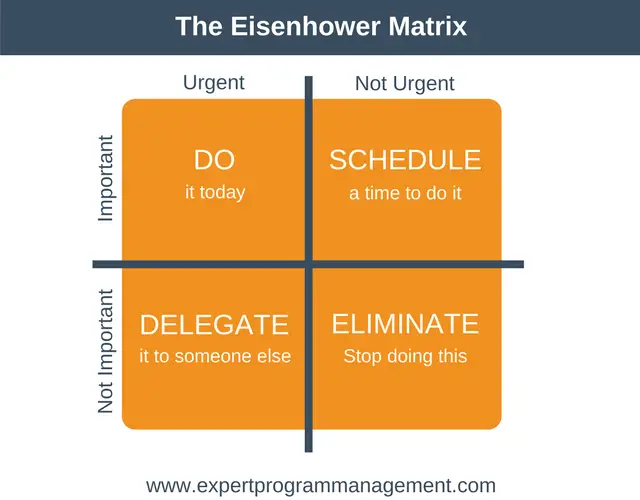
If you actually organized all the tasks into one of the four quadrants, you will be a far more productive place. Here is a video of it in practice:
But how to stop procrastinating?
Anisa Horton at FastCompany offers an idea of scheduling procrastination which he borrowed from Charles Duhigg:
“this is something I actually found when writing the book. The more you focus, the more that focus becomes a habit. So, willpower is like a muscle, right? It’s this muscle that you can build up, and it gets tired, but the more you exercise it, the stronger it gets. The same is true of our ability to focus. The more you practice focusing, the easier focusing becomes. And so the other answer for procrastination is, don’t beat up on yourself. Let yourself practice going longer and longer and longer without taking a five-minute break to check Facebook because after three or four weeks, after three or four months you’ll be able to sustain focus much longer, but the key is, you can’t change everything overnight. You can’t suddenly say, I want a brand new habit tomorrow and expect it to be east and effortless. It’s something you have to give yourself permission to take a little bit of time to practices because you’re building up neuro pathways associated with certain behavior and those neuro pathways just build up over time. You can’t speed up that process any more than is natural.”
Another personal favorite is the Pomodoro Technique.
- Choose a task to be accomplished.
- Set the Pomodoro to 25 minutes (the Pomodoro is the timer)
- Work on the task until the Pomodoro rings, then put a check on your sheet of paper
- Take a short break (5 minutes is OK)
- Every 4 Pomodoros take a longer break
Other techniques
Visual Cues: Let’s say you need to learn a list of vocabulary words. You commit to reviewing 25 words every day. You can get a bowl of 25 paperclips–25 to be exact. Each word you review, you flip the clip to an empty bowl. And you keep going until the first bowl is empty. Repeat tomorrow.
Surrender your cell phone. Seriously, you know you cannot live without it, so let’s meet half way. When you get home, give your phone to your parent. You can give yourself an allowance of say 30 minute phone break to do all the things you normally do. A growing body of research is showing that Cell phone usage is driving anxiety levels up.
Exercise Self Control. Don’t have any? There is an app for that. You can block websites and apps that distract you. The nice thing is you can give yourself an allowance. So you can block Youtube for say 1 hour and then give yourself a break to do so. There is an app called Focus for your iphone that does the thing. More iphone apps for productivity here.

Focus Writer helps you concentrate on your writing on a mac. StayFocusd increases your productivity by limiting the amount of time that you can spend on time-wasting websites through this Chrome extension.
Practice mindfulness daily. Why? “Emotional regulation, to me, is the real story around procrastination, because to the extent that I can deal with my emotions, I can stay on task,” says Pychyl, a faculty member in the Department of Psychology at Carleton University (Ottawa, Canada).
Podcasts worth listening to
- A whole podcast dedicated to procrastination called iprocrastinate.
- Jeff Saunder on 5 Strategies to conquer procrastination.
- NPR on how to be a productive procrastinator
- Stop Procrastinating With Timothy A. Pychyl. Dr. Pychyl maintains a website for Procrastination research.
- Mary Lamia, author of What Motivates Getting Things Done: Procrastination, Emotions and Success at Success Insider
Where to start?
Simply pick one of these strategies and test it for one week. Run it like an experiment. Next week try a different strategies.
Well worth reading is this article on the Science Behind Procrastination.
Love of Learning: Podcasts worth listening to
The podcast world is the love of learning’s best friend.
Let’s start with an interview with Josh Waitzkin, an 8x US National Chess Champion, a 2x Tai Chi Push Hands World Champion, and a Black Belt in Brazilian Jiu Jitsu. He is the author of The Art of Learning (require reading to train with me). Josh is now pursuing paddle surfing where I’ve been working with him for the last year. He is the most positive, inspirational person I know and I’m incredibly thankful he agreed to come on the show. Josh’s Core Training Principles –
- Reduced Complexity (end game before opening) – training with less variables to focus on larger, high-level principles concepts.
- Firewalking – learning from the experience of others using empathy and visualization.
- Mental Representations – have a clear mental model for a skill your practicing. Like modeling an Agassi forehand.
- Growth comes at point of resistance – we learn the most when we’re outside of our comfort zone.
- Living on the other side of pain
- Train at the few to internalize the many
- Finding your own way
- Beacon of Quality
- Depth before Breadth
- Loving the storm
- Have your compass on
- Most important Question
- The Downward Spiral – Usually it isn’t the first mistake that’s disastrous, but the first mistake tends to make the second more likely.
- Philosopher vs. Philosophologist – We tend to study the work of those who study the experts instead of studying the experts directly.
SoundCloud Widget
Think of domain and you can probably plug in and find a podcast to educate and entertain you. So many to explore, but I will highlight a few that do a deep dive. Check out our the posting for Curiosity, the sibling for a love of learning. Here are some of my favorites:
Every episode Scott Barry Kaufmann interviews the most intriguing people form the world of psychology, diving deep into their research with good humor. Some episodes to get you started:
Mike Rowe of Dirty Jobs fame, takes the guy in the bar format to share a story, a mini biography of famous people past and present. Episodes are typically five minutes, but will take you far deeper into than you would expect. Each episode starts with a avague but intriguing aspect that leaves you guessing who he is talking about. Check out these episodes:
- Episode 69: “A Little Dab’ll Do Ya!”
- Episode 67: Charlie’s Big Break
- Episode 59: A Hero Under the Influence
- Episode 54: The Boy Who Loved to Fly
- Episode 15: Sorry, Wrong Number
- Episode 3: Clean Up On Aisle 4!
LASZLO MONTGOMERY hails from Claremont California whose business takes him to China. Amateur historian does not do justice to this world class sinophile. You can listen from any episode as he does it by topic, not by chronology. Some topics take 2 or 3 or even 10 episodes. I have learned so much.
In “Hardcore History” journalist and broadcaster Dan Carlin takes his “Martian”, unorthodox way of thinking and applies it to the past. Was Alexander the Great as bad a person as Adolf Hitler? What would Apaches with modern weapons be like? Will our modern civilization ever fall like civilizations from past eras? This isn’t academic history (and Carlin isn’t a historian) but the podcast’s unique blend of high drama, masterful narration and Twilight Zone-style twists has entertained millions of listeners.
This moment demands an explanation. This show is on a mission to find it. Only what you want to know, none of what you don’t. Hosted by Michael Barbaro. Powered by New York Times journalism. Twenty minutes a day, five days a week, ready by 6 a.m.
Author Nigel Warburton reads from his book Philosophy: The Classics which is an introduction to 27 key works in the history of Philosophy.
Fresh Air from WHYY, the Peabody Award-winning weekday magazine of contemporary arts and issues, is one of public radio’s most popular programs. Hosted by Terry Gross, the show features intimate conversations with today’s biggest luminaries.
Have fun discovering the hidden side of everything with host Stephen J. Dubner, co-author of the best-selling “Freakonomics” books. Each week, hear surprising conversations that explore the riddles of everyday life and the weird wrinkles of human nature—from cheating and crime to parenting and sports. Dubner talks with Nobel laureates and provocateurs, social scientists and entrepreneurs — and his “Freakonomics” co-author Steve Levitt. After just a few episodes, this podcast will have you too thinking like a Freak. Produced by WNYC Studios, home of other great podcasts such as “Radiolab,” “Death, Sex & Money,” and “On the Media.”
Success comes from habits
There is a short, but excellent article summarizing Tom Corley’s research he published in his best-selling book “Change Your Habits, Change Your Life,” on what financially successful people do in comparison to lower earning individuals. I have added my own commentary to several, but do read his article.
- They get up early
Well begun, half done, so goes the saying. It is not getting up early that matters as much as what you do when you are up. Getting up early allows for several other habits take hold–exercise, reading, quiet contemplation. One excellent practice is known as morning pages whereby you aim to write 750 words fist thing.
- They read, a lot
Feed your wisdom/knowledge and Strategic Thinking. His research suggests that you are better focusing on non-fiction such as biographies. What should you read? Here are a few lists to get you started:
- They spend 15 to 30 minutes each day on focused thinking
Perhaps this can be split into two parts: Focused thing vis-a-vis your goals and tasks at hand, and focused attending to yourself such as a mindful practice. Tim Ferris figures 85% of his guests on his excellent podcast have some sort of contemplative practice.
- They make exercise a priority
Research shows Cardio exercise is not just good for the heart and waist, but your brain as well from stress and anxiety to depression and many others. Watch John Ratey explain
- They spend time with people who inspire them
Role models and mentors are powerful inspiration. Chris Peterson famously summed a life worth living as “Other People Matter:
The Greater Good Society reports that “Results from some studies—as well as end-of-life conversations—indicate that many people count their relationships as the most meaningful part of their lives, even when those relationships are difficult or strained.” There is one special relationship that matters: Mentors:
- They pursue their own goals
The Ritz Carelton has curated seven great TED Talks on goal-setting and how to follow through on your dreams.1) Keep your goals to yourself by Derek Sivers
In this three-minute TED Talk, the speaker shares psychological evidence about the importance of keeping your goals quiet. You’ll have a better chance of following through on your plans if you don’t share them with others.
2) Try Something New for 30 Days by Matt Cutts
In this three-minute TED Talk, the speaker shows how small steps can lead to big adventures. Inviting activity into your life seems to lead to a richer experience.
3) 5 Ways to Kill Your Dreams by Bel Pesce
In this six-minute TED Talk, the speaker shares five lines of thought that will keep you from reaching your goals, and she also emphasizes the significance of the journey.
4) Four Keys for Setting and Achieving Goals by William Barr
In this eight-minute TED Talk, the speaker shares how he was able to build one of the nation’s largest home improvement companies.
5) If You Want to Achieve Your Goals, Don’t Focus on Them by Reggie Rivers
In this 11-minute TED Talk, the speaker shares how focusing on the goals can actually prevent you from achieving your goals. By focusing on your behaviors, you will be more driven to follow through.
6) The Key to Success? Grit by Angela Lee Duckworth
In this 6-minute TED Talk, the speaker shares how grit is a key ingredient for success. She encourages the audience to live life as a marathon and not a sprint.
7) The Power of Believing That You Can Improve by Carol Dweck
In this 11-minute TED Talk, the speaker shares how adopting a growth mindset can open you up to greater success. She encourages the audience to see a challenge as a “yet” opportunity.
- They get enough sleep
You need sleep to draw on vitality. Tom Rath explains getting Fully Charged:
- They have multiple incomes
Obviously financial wealth requires income. Multiple incomes take precedence especially if they are self-sustaining. Tim Ferris explains in his book the Four Hour Work Week.
- They avoid times wasters
Hopefully you do not see this blog as a time waster. Even the pope has spoken out against Digital Media filters: “When media and the digital world become omnipresent, their influence can stop people from learning how to live wisely, to think deeply and to love generously,” he wrote in the letter.
Going to IPEN? Stop by my session

Book Review: Grit
Angela Lee Duckworth has released her long awaited book that follows up from her stunnng Ted Talk:
Angela has spent all of her academic career investigating what she believes is one of the defining characteristic of successful people.
The book opens with the drop outs of westpoint, which she spoke on her Ted talk. She expands on her research there and follows up with Spelling Bees. While familiar grounds, she goes in much deeper with a meander through human achievement research with the likes of Galton, Ericsson, Csikszentmihalyi, Willingham, Cox, and several others. Her pulling together, in one volume, proves the most useful part of the book. While her own anecdotes provide some insight, but lack weight. Her own research is only in its infancy. So the details she provides gives useful backdrop for the coversation, except the conversation is one sided. She really does not address can one have too much grit? The answer is Yes!
Having just completed the book, I have aimed to pull together the best strategies for building your grit (not all of which Angela discusses):
- 1) Develop a life philosophy or mission statement.
- 2) Cultivate optimism
- 3) Embrace a growth mindset.
- 4) Engage in deliberate practice. It is not just the 10,000 hours, but how you spend them that are key.
- 5) Practice mindfulness daily. 85% of leaders in their fields do; you should too.
- 6) Learn about and follow paradigms of Grit. She gives several examples in the book like:
- Quarterback Steve Young
- Coach Pete Carroll
- Comedian Francesca Martinez
On Angela’s website she is asked about parenting and teaching for Grit and replies:
The entire book is about teaching grit. Before I became a psychologist, I was a classroom teacher. It was as a teacher that I discovered how important psychology was to a child’s achievement. It’s not an exaggeration to say that every chapter in this book has special relevance to teachers. Chapters Two and Three might be especially useful when explaining the importance of effort (versus talent) to students. Chapters Six, Seven, Eight, and Nine on interest, practice, purpose, and hope are where I define the four psychological assets that lead to grit. In Chapter Nine, I talk about parenting for grit—but the same dynamics play out in the classroom. In Chapter Ten, I explain why Harvard and other colleges are eager to see students cultivate their grit in extracurricular activities. Finally, a teacher who wants the classroom culture to support grit will find Chapter Twelve full of examples of how to do that.
That is one significant problem with the book. Her research reveals little about how to cultivate grit in real, normal circumstances. Million dollar organizations like West Point and Seahawks are not the real world. Paul Tough did a far better job outlining and illustrating a plan in How Children Succeed.
Ethan Ris takes her task in an important Op-Ed for the Washington Post:
There’s more to the story, however. In a recent peer-reviewed article in the Journal of Educational Controversy, I examined the history of the discourse surrounding this special trait. It far predates Duckworth’s research, of course. My investigation led me to two conclusions. The first is that the widespread assumption that grit is a salient concept for low-income students is a stark misconception. The second is that while grit theory offers little of value to those disadvantaged students, it can certainly harm them, by romanticizing hardship.
Still, this is an important book. Already number 13 on Amazon (Behind Dr Seuss, a Deit cookbook, a pre-teen story about Greek Gods, Harry Potter, Alexander Hamilton, Bill Clinton, and two adult colouring books–so clearly not as important as all those escapes from our Gritty world, but still important), this book will be a big seller this year.
Book Review: Grit
Angela Lee Duckworth has released her long awaited book that follows up from her stunnng Ted Talk:
Angela has spent all of her academic career investigating what she believes is one of the defining characteristic of successful people. Having just completed the book, I have aimed to pull together the best strategies for building your grit (not not all Angela discusses):
- 1) Develop a life philosophy or mission statement.
- 2) Cultivate optimism
- 3) Embrace a growth mindset.
- 4) Engage in deliberate practice. It is not just the 10,000 hours, but how you spend them that are key.
- 5) Practice mindfulness daily. 85% of leaders in their fields do; you should too.
- 6) Learn about and follow paradigms of Grit. She gives several examples in the book like:
- Quarterback Steve Young
- Coach Pete Carroll
- Comedian Francesca Martinez
The book opens with the drop outs of westpoint, which she spoke on her Ted talk. She expands on her research there and follows up with Spelling Bees. While familiar grounds, she goes in much deeper with a meander through human achievement research with the likes of Galton, Ericsson, Csikszentmihalyi,